
Cart is empty
Swimming Pools
HOW DOES A SWIMMING POOL IMPROVE YOUR HOME?
When you pry the remote control, smart phone or controller from the pale, clammy hand of your tweenager and insist he or she go outside, do you get a slack-jaw or a blank look in response? Have they become so digitized that they have forgotten that playing outdoors is even an option?
Bottom line: your family needs a place to have fun and relax that doesn’t involve social media, Chromecast, or virtual realities. It should also involve no malls. In fact, no road trips at all; no gas stations, no parking lots, no traffic jams. Just your own little happy family in your own backyard with your very own swimming pool.
A swimming pool offers all kinds of benefits as well as ALL KINDS OF FUN!
- A pool provides a place for your couch potatoes to be active and healthy while having a great time.
- It’s a spot for them to reconnect, to interact, to restore those face-to-face relationships that get kicked to the curb by Twitter and Instagram.
- It can encourage other relationships as well; invite the neighbors, host a pool party for your extended family, relax under the stars with your significant honey.
Whether you own acreage or just a small patch of grass, there is a pool that will work for you. They come in a wide variety of shapes and sizes, and are available in a price point for every budget. Above-ground, in-ground, round, oval or kidney shaped; the options are unlimited but the benefits go across the board.
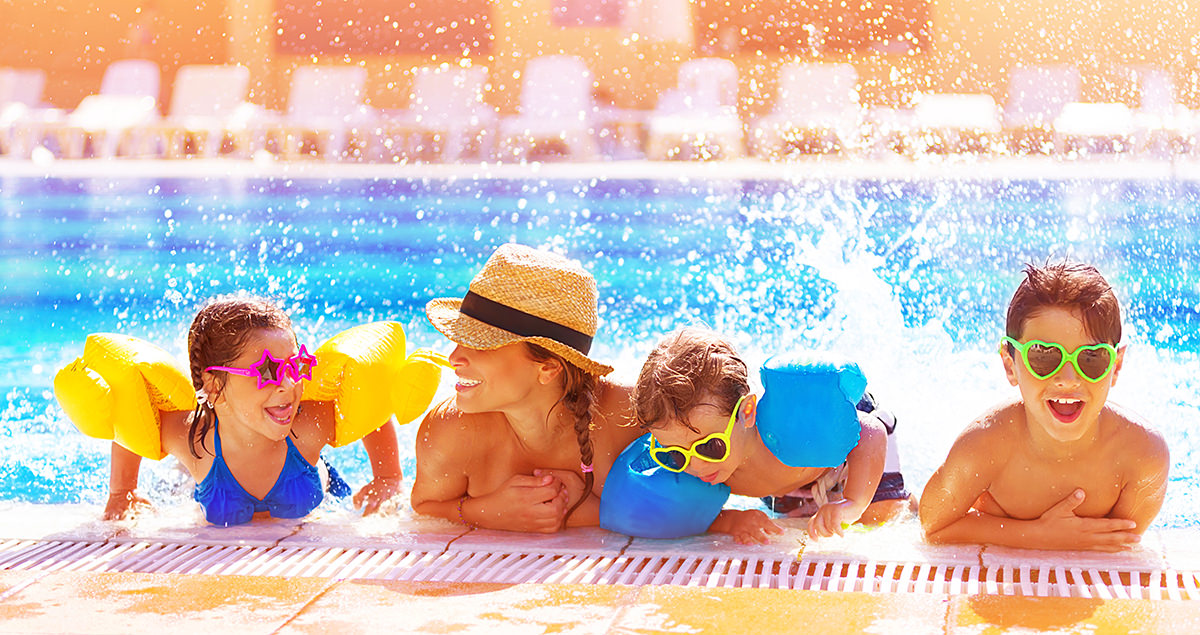
Invest in your family; invest in your health; invest in your happiness; invest in a swimming pool.
SWIMMING POOL BASICS
How Do I Decide Where to Put the Pool?
Ideally your swimming pool should be easily accessible and in view of your house for your convenience and the well-being of your family. Avoid trees as much as possible; placement in a sunny area will help to keep your water warm and clean. You also want to pick a spot that is as level as possible to aid in easy installation. You will require electricity to run your filtering system; think about that as well when planning your location.
How Big and What Shape Should My Pool Be?
A swimming pool professional can help you determine the best option for your home and space, but there are some things you may want to keep in mind. The space you select as the most appropriate spot for your pool will dictate the size and shape. When considering an above-ground pool, keep in mind that while an oval pool may have more aesthetic appeal, a round pool will give you more actual swimming space. An oval above-ground pool will also require sidewall braces that will stick out from the sides; those will need to be added to your measurements. In-ground pools will, of course, give you more options for sizes and shapes.
What About Landscaping?
When you are deciding the location, shape and size of your pool, consider, also, future additions to your pool area. Your pool will become the focal point of your backyard so you might as well capitalize on it. If you are putting in an above-ground pool you will want to look at deck options. Decking can be as simple or elaborate as you desire; you can make it large enough for sun-bathing and for pool-side parties; it can be constructed of wood or resin. Both an in-ground and above-ground pool may inspire harmonizing landscaping, including shrubs, hedges, and garden paths and ornamental fencing.
Isn’t It Hard to Keep a Pool Clean?
Keeping your pool pristine doesn’t have to be a complicated process. Half the battle is prevention; keep your chemicals balanced and make sure your equipment is working and you will avoid most of the issues that can potentially plague a pool owner. Cloudy water, algae, dirt and debris can all be prevented with a little preemptive effort
The options for sanitizing and filtering pool water are many; the most common filter option for an above ground pool is a sand filter, while chlorine and bromine are the most commonly used chemicals. A pool professional will help you decide what system would work best for your needs.
What Add-ons Should Buy?
There are a variety of accessories and conveniences that can be added to your swimming pool experience. Winter covers are essential, of course, to keep your pool clean over those colder months. A good quality cover will keep leaves and other debris out of the pool, which will make opening your pool much easier. A mesh cover can be used in or out of season to keep trash out and will prevent water from building up on top of the cover. Solar covers will help keep your water up to 10 degrees warmer; you can also add a heater to your pool equipment that will extend your swimming season. A pool alarm is a great idea to keep your pool safe for children and pets. You can also make your life easier by employing an automatic pool cleaner to aid in keeping the pool clean and clear by vacuuming up leaves, grass, insects and other waste. Pool timers can be utilized to turn your equipment on and off as needed, which will, in turn, decrease your energy consumption. Pool add-ons aren’t all work and no play; both in ground and above ground pools can accommodate fountains, waterfalls, special lighting and sound systems.
The Family Leisure Online Pool School
Everything you need to know about a swimming pool, from the basics of maintenance to do-it-yourself swimming pool installation, is available in the Family Leisure Online Pool School. View informative videos on the following subjects:
Pool Water Sanitation
There are many ways to keep your pool clean, healthy and safe for all including prevention, treatment and filtration. The most common sources of debris, dirt, pathogens and contaminants are the environment, the swimmers themselves and the chemicals placed by the owner to help maintain the swimming pool. Prevention is quite effective when utilized with the swimmers.
The largest source of contaminants is typically the individuals swimming in your swimming pool. Be sure to provide areas to clean off before swimming, such as a sink for cleaning hands or a hose and a basin for cleaning feet. Encourage swimmers in your pool to shower before they go swimming. But sometimes these suggestions may be impossible to achieve; sweat, cosmetics and suntan lotion will undoubtedly make their way into your pool water.
The environment can be a significant source and prevention can be difficult, particularly when compared to thwarting contamination of your water through the swimmers. Dirt, dust, leaves and branches blown into your backyard by the wind; bacteria, viruses and algae spores in raindrops falling into your water; birds dropping their waste into your swimming pool; the environment will literally throw trash at swimming pools.
This is where treatment and filtration come into play. Why? Organic pathogens such as bacteria, protozoa, viruses and fungi (Giardiasis, Cryptosporidiosis and Otis Externa, just to name a few) create issues such as skin rashes, respiratory infections and diarrhea. Read below for more information on pool water filtration and disinfection.
Pool Water Filtration
 Typically water is pulled from the swimming pool through skimmers and strainers placed at regular intervals in the pool wall. A pool pump creates the pressure, sucking water through the strainer for larger debris such as leaves and hair, and then forcing the water through a sand filter to clear out smaller debris.
Sand filters (the 26" Pool Sand Filter System is pictured to the right) are most common with swimming pools. Microscopic contaminants larger than 10 micrometers are typically filtered out through a pressure fed filter that sometimes requires a “back-wash” to improve efficiency. Filtering the pool water with a pool pump and sand filter should prevent pool water issues.
The final step is the water recirculating into the pool, typically through a water return commonly called an eyeball. During the summer owners can run their pump 24 hours a day, but most rely on a timer to control their pump to save electricity
There are two types of pumps: the self-priming pump, which can be placed above the pool’s water level, and the flooded suction pump, which relies on gravity and must be placed below the pool’s water level. A typical above ground pool relies on a sand filter fed by a flooded suction pump. Both require regular maintenance and care; expect the sand in the filter to last up to eight years, but it should be replaced after every season to avoid sanitary issues. A pump can require between 500 watts to 2,000 watts, depending on your pool’s size.
Other types of filtering systems: Thri-Chlor Feeders, UV Systems, Ionization Systems, Saline Chlorination & Electronic Oxidation
How will you heat your swimming pool?
New owners rarely consider how they will heat their swimming pool. Typical swimming pool water heater choices include natural gas and propane, but electric and solar power options do exist as well.
WARNING!!! BACKWASHING!!!
The side of your water filter should hold a pressure gauge. When the needle in the pressure gauge has entered the red area a backwash of the water filter is needed! Be safe and avoid maintenance issues. Don’t wait any longer… Do it right now!
Pool Water Disinfection
Bromine and chlorine are effective sanitizers, both utilizing halogen-based oxidizers to kill contaminants. Hot tubs and spas frequently use bromine to sanitize water, while swimming pools typically rely on chlorine. Pictured (right) is a 4 lb. tub of 3" Chlorine Tablets.
Both bromine and chlorine will quickly oxidize and destroy organic contaminants such as viruses and bacteria, while also destroying algae, a common problem in pools. Chlorine breaks down rapidly in sunlight, so a compound mix of chlorine and a granular acid is used to extend the life of the water.
Chloramines will appear in most pools, a combination of the chlorine mixing with nitrogen-based wastes in the water, creating the nose-stinging chlorine smell found in gyms, private clubs and rooms containing indoor pools. Shocking the pool will help eliminate this smell and chlorinates, typically every two weeks while the pool is active, such as during the summer.
Join the Discussion:
Comments
No posts found